

[Tap to Play Video]
After a major earthquake, your tap water could stop flowing for days. This video shows how to keep your family safer with long-term emergency drinking water that can sit ready for decades.
We break down FEMA/CDC water recommendations, why plastic bottles fall short for long-term storage, and compare Aqua Emergency Water, Safe Life Water, Blue Can Water (status update), and Open Water—so you can quickly pick the right option for your home and budget.
FEMA/CDC recommend a minimum of 1 gallon per person per day. However, we suggest 1.5 gallons per day per person if its hot or you will be physically active.
Disclosure: Affiliate links — we may earn a commission at no extra cost to you.
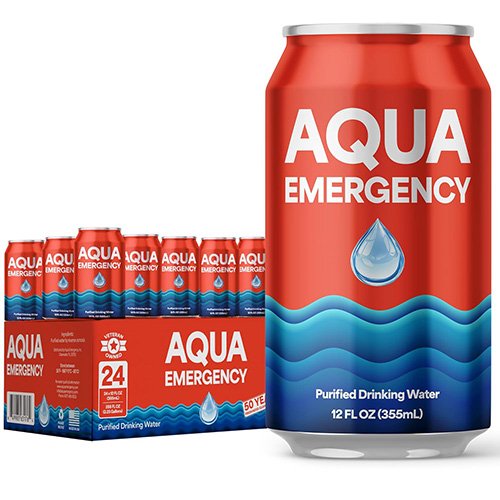
- Best overall value
- 50-year shelf life
- 2.5 gallons per case
- MorePrepared.com
- use code CHR5 for 5% off
- Amazon.com
- EmergencyKits.com
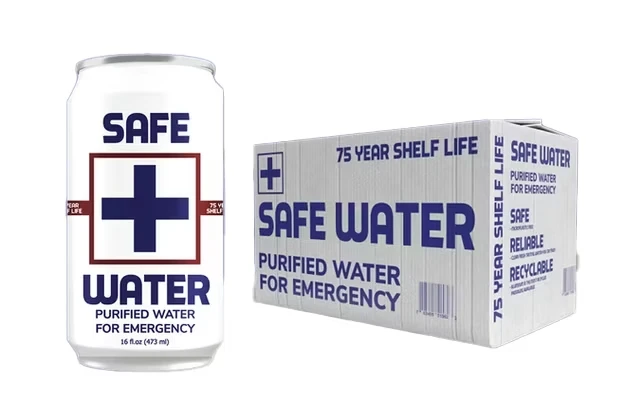
- 75-year shelf life
- 3 gallons per case
- MorePrepared.com
- use code CHR5 for 5% off
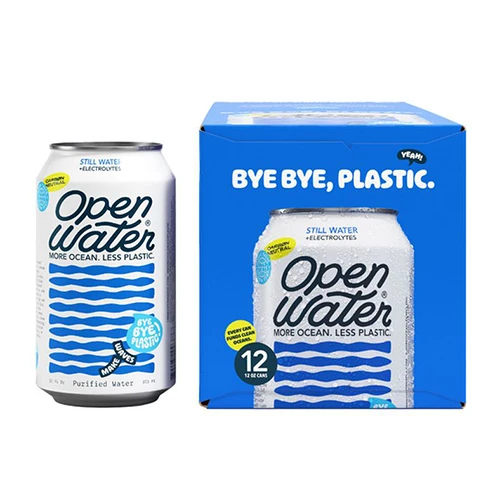
- 2-year best drink by date
- replace & drink every few years
- can last much longer
- Half the price per gallon
- 2.5 gallons with 24 cans
- Amazon.com
Watch the video above or read the blog below…
Why Every California Family Should Store Emergency Water — and How To In 5 Minutes
After a major earthquake, your tap water could stop flowing for days—and most California families aren’t ready. The good news: you can fix it in about five minutes.
The simplest long-term fix is sealed emergency canned water—so your family’s emergency drinking water is covered for decades.
At California Home Resilience, we help busy West Coast families improve home safety with quick, practical upgrades that require no DIY skills or complex setup. We focus on simple, reliable solutions for earthquakes and power outages—curated for maximum safety impact with minimal effort.
Emergency water is one of the highest-impact, lowest-effort steps you can take.
Why Emergency Water Matters After an Earthquake
During a major quake, water mains can break, treatment plants can be damaged, or contamination can make tap water unsafe. Even relatively short disruptions become dangerous surprisingly fast—especially for children and older adults.
- Children can begin dehydrating within three to eight hours without enough fluid, according to the Mayo Clinic and American Academy of Pediatrics.
- For adults, the widely used “rule of three” says most people can only survive around three days without water.
After an earthquake, if your drinking water is disrupted, your home may have to work like a little desert camp—fully self-reliant for water.
Waiting in line for bottled water distribution if the water service outage is widespread or the roadways become impassible isn’t a plan. Having your own supply at home gives you immediate safety and peace of mind.
Why Plastic Bottles Are Not a Long-Term Solution
Many households rely on plastic water jugs or cases of bottled water. They feel like a solution—but they’re really built for short-term use:
- Typically need replacement every 1–2 years
- Plastic can weaken and leak over time
- May leach BPA, microplastics, and PFAS into the water
- Translucent plastic lets sunlight reach the water, which can encourage algae and bacteria growth
- Require constant rotation—easy to forget in a busy household
For time-pressed families, that rotation cycle is a recipe for ending up with expired, drained or contaminated bottles of water right when you need it most.
Why Canned Emergency Water Is a Better Solution
Canned emergency water is engineered for long-term safety and reliability:
- Purified and UV-sterilized to prevent bacteria growth
- Hermetically sealed cans to keep contaminants out
- Aluminum packaging—no BPA, microplastics, or PFAS from the container
- Designed to resist leaking over time
- Manufacturer-rated shelf lives of decades (50+ years, depending on brand)
With a manufacturer-rated shelf life of 50 years or more for some products, you can stock it once and your emergency water is essentially covered for decades.
How Much Water Should You Store? (FEMA & CDC)
Federal guidance from FEMA and the CDC is clear:
Store at least one gallon of water per person per day—
3 days minimum, 2 weeks ideally.
Roughly:
- ½ gallon per person per day for drinking
- ½ gallon per person per day for cooking and sanitation
In hot conditions or with higher activity levels, aim closer to 1.5 gallons per person per day.
For a family of four, that looks like:
- 12 gallons minimum (3 days)
- 56 gallons ideal (2 weeks at 1 gallon per person per day)
Most off-the-shelf earthquake kits don’t get you close. Many include only about a fifth of a gallon per person, with water that expires after about 5 years—far too little for a real emergency.
Canned emergency water makes it realistic to hit FEMA/CDC targets without constant rotation.
Where and How to Store Canned Emergency Water
Manufacturers generally recommend:
- Keep cans in their original box for protection.
- Store within the temperature range on the packaging (commonly around 42°F to 125°F).
Good storage locations in many California homes:
- Garage (away from direct heat sources)
- Interior closet
- Under-stairs storage
- Utility room
- Shed or storage area that stays within recommended temperature ranges
Unlike plastic jugs, properly stored canned water is much more tolerant of real-world garage and storage conditions without degrading.
Top Emergency Canned Water Options for California Families
Below are some of the leading options discussed in the video, along with how they fit into a simple, practical plan.
1. Aqua Emergency Water (Best Overall Value for Most Families)
Aqua Emergency Water is a popular choice and one of the best overall values:
- 2.5 gallons per case (almost three days of emergency water for one person)
- 50-year manufacturer-rated shelf life
- Widely available from multiple retailers
Pricing & discount:
MorePrepared.com typically has very competitive pricing. You can use the code CHR5 for 5% off Aqua Emergency Water (and Safe Water below) through March 31, 2026. See the links and latest details on our emergency water page.
2. Safe Water (Longest Shelf Life Recommended)
Safe Water is a strong alternative when you want the longest manufacturer-rated shelf life:
- 3 gallons per case (exactly the minimum three-day supply for one person)
- 75-year manufacturer-rated shelf life
- Used in some institutional and hospital settings
- Higher cost per gallon and available from fewer retailers
You can also use CHR5 at MorePrepared.com for 5% off Safe Water through March 31, 2026.
3. Blue Can Water (Status Update)
Blue Can Water was once a widely recommended option for long-term emergency storage. As of this writing, they have paused production but stated that they plan to restart. If you’re considering Blue Can, check the latest status on their website or with retailers before building your plan around it.
4. Open Water (Budget-Friendly / Shorter-Term Option)
If you’re not planning to stay in your current home for many years, or you want a lower upfront cost, Open Water can be a practical, budget-friendly choice:
- Ultra-purified canned water
- Typically about half the price of “emergency-grade” canned water
- Labeled with a 2-year “best drink by” date (this is a quality date, not a hard expiration)
- Best if you’re comfortable rotating and drinking through your supply on a regular schedule
Open Water is great for renters, people expecting to move soon, or anyone who prefers a lower-cost entry point with more frequent rotation.
What Does Emergency Canned Water Typically Cost?
For planning purposes:
- Emergency-grade canned water designed for decades of storage typically runs around $60 per case shipped, depending on brand and retailer.
- Open Water and similar shorter-term options are usually about half that cost per case, with the trade-off of shorter “best drink by” dates and more frequent rotation.
Remember that manufacturer shelf-life claims are based on their own testing and assumptions. Always follow storage instructions on the packaging, and when in doubt, consult the manufacturer.
A Simple, High-Impact Preparedness Step
Ordering canned emergency water takes just a few minutes, and once it’s stored properly, it’s something you probably won’t have to think about again for decades.
At California Home Resilience, we focus on straightforward preparedness steps that give you long-term peace of mind without turning your life upside down. Long-lasting emergency water is one of the smartest, fastest upgrades you can make for your California family’s safety.
Support Our Mission
Some of the links on this page are affiliate links, which means we may earn a small commission if you choose to buy through them—at no additional cost to you. This helps support our work creating simple, research-driven guides to help California families stay safer at home.
If you found this helpful, you can:
- Order your emergency water using the links on this page
- Subscribe to California Home Resilience on YouTube for more “simple home safety—in minutes”